
Until You Cannot Unsee Him
A Letter on Why We Must Hold on to the Prophet ﷺ

By Anse Leila Anwar Pačariz
Allow me to tell you what I saw with my own eyes, because I think it explains everything I am about to say better than any argument could.
Some years back, I went for my firstʿumra. I was full of dreams and expectations.
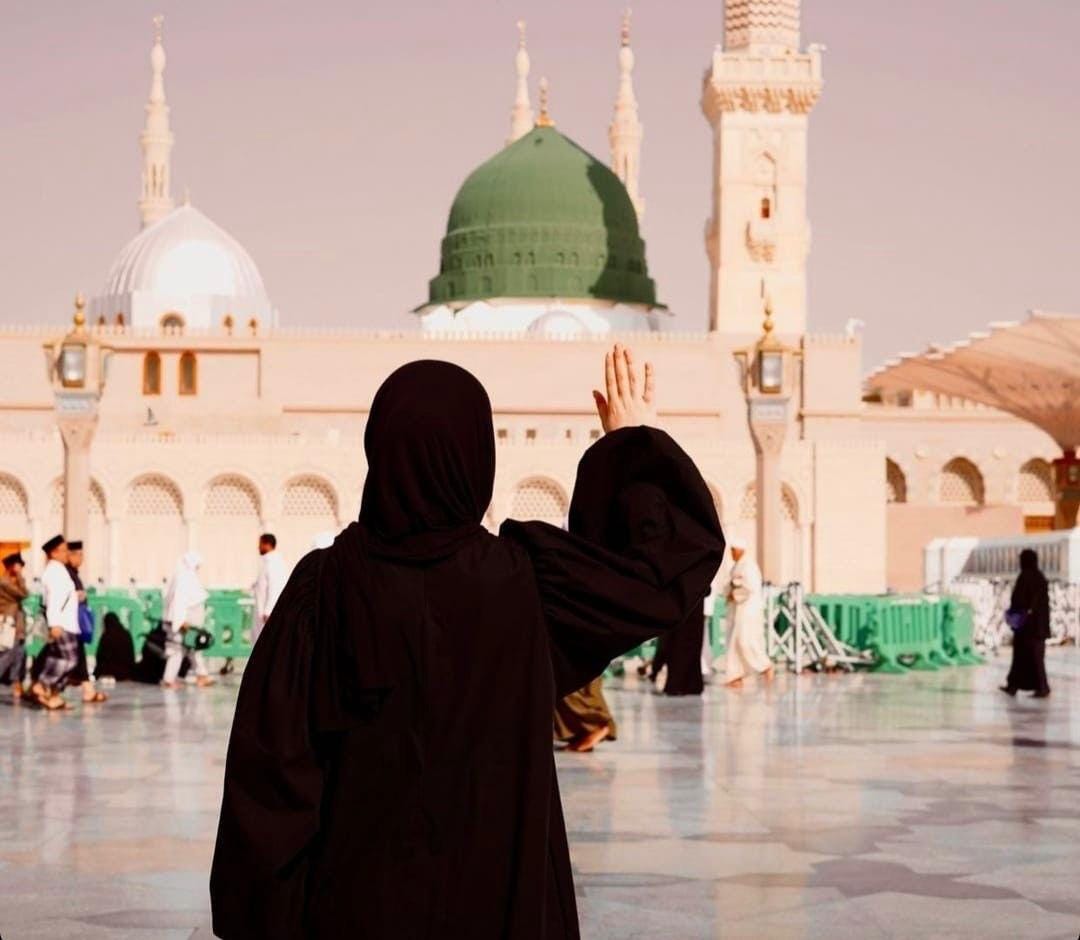
Our first destination was Medina. I was prepared for tears, a little bit afraid of what will happen when all my emotions are set free by Rasūlullāh’s ﷺ proximity. Will I tell him everything all at once, will I forget something or someone, what if I can’t stop crying?! Instead, I was shocked by the amount of peace and calmness I felt in his ﷺ mosque, close to him ﷺ. How Rawḍa’s hug made me feel safe for the first time in my life. Even outside, at the door, a beautiful, random lady greeted me and gave me a gift. Sajjāda and masbaḥa. My favorite things. Medina soothed every wound I had and calmed every fear I possessed.
Five days later, we went to Mecca. First destination: Haram al-Sharīf.
Oh, my poor heart almost exploded. One of my dear friends instructed me not to raise my eyes until I reached the Kaaba. When I finally saw her beauty, I was breathless; my mind ceased to exist for a second, and Kaaba’s magnet pulled my love to it, so it stayed there forever.
I also felt something I was not prepared for.
The crowds did not part for anyone. The pushing did not care whose mother you were, whose daughter, how tired your feet were, how full your heart was trying to be in that moment. The taxi drivers were sharp and frowning, security soldiers impatient and aggressive. I know, I know, they have reason to be. Just stating the facts.
And then the thought came, and it has never fully left me since: This is the difference between a world with him ﷺ and a world without him ﷺ. Mecca without him ﷺ is a survival. Medina is what happens when mercy moves in and decides to stay.
Every now and then, I hear about a movement out there, present in most generations in some shape or form. It seems like it’s growing quietly, telling sincere people, some of them new to Islam, some of them young, some of them simply searching, that they don’t need Rasūlullāh ﷺ and his words. They claim the Quran is enough by itself, his ﷺ sunnah is “man-made,” and the safest, purest Islam is the one where you and your Quran are alone together, with no one standing between you and the Words. “He was just a messenger.”
It sounds spiritual. It looks like devotion.
It is the opposite.
I don’t write these lines as an academic, scholar, or anything like that. I am writing them as a woman whose īmān was saved too many times by a hadith or a situation learned from sīra, when the gentleness, mercy, kindness, and attitude of Rasūlullāh ﷺ was showing me how Quran should be lived.
It started years ago, the first time I really sat with his ﷺ life—not as history, but as a person I was falling in love with. The way he ﷺ laughed with his companions. When he ﷺ stopped to free a sparrow’s nest from danger. The day he ﷺ comforted a weeping tree trunk. The way he wept, openly, like a man whose heart could break, when his son Ibrāhīm died in his arms. The way he never once, not once, in all his power, all his victory, raised his hand against someone weaker than him.
“Indeed, in the Messenger of Allah you have an excellent example.”
Quran 33:21
How could I possibly love the Quran and not want to know what that excellent example looked like in a human life?
The Quran told me to look at him. So I looked. And once you have looked at him—through the hadith, through the sīra, through the small details that only someone who loved him ﷺ would have bothered to remember and pass down—you cannot unsee him.
When someone tells me, “Just follow the Quran,” what I hear is, forget the way Prophet Muhammad ﷺ looked at the poor. Forget the way he kissed his grandchildren in front of men who thought that was undignified and told them mercy was not weakness. Forget the way he never let a guest leave his table hungry, even when his own family had nothing. May Allah’s peace and blessings be upon him always and forever.
Without him, without what he showed us with his own body, his own voice, his own days and nights, we would not even know how to stand in front of Allah. We would be just guessing.
And when you let people guess about something this sacred, with nothing to hold them accountable to a transmitted, examined, scrutinized record—you do not get purity. You get whatever each person’s heart was already inclined toward. Some hearts are inclined toward harshness. Some toward control. Some toward justifying whatever they already wanted to do.
That is Mecca without Medina. Everyone pushing toward their own qibla.
I want my children, my loved ones, my students, the women, especially the ones still finding their footing, to know something that I find almost unbearably beautiful: The scholars who passed down his words were not careless. They were some of the most painstakingly careful people who have ever lived. They built an entire science just to protect his honor from being misquoted. They asked every single person in every single chain: Did this person actually meet who they say they met? Were they honest? Did their memory hold? Did anyone catch them lying, even once?
Imam Bukhārī, may Allah be pleased with him, is said to have examined roughly six hundred thousand narrations and kept only a small fraction—the ones that passed every test. That is not a man collecting rumors about someone he loved. That is a man so in love that he refused to let anything false touch his beloved’s name.
And when a hadith ever seemed to contradict the clear words of the Quran itself? The scholars set it aside without hesitation. The Quran always stayed the criterion. That is not a weakness in the system—that is how much they trusted Allah’s words above every other voice, including the voices of well-meaning narrators. The system protects itself.
This is not a fragile inheritance, easily knocked over by a clever video online. It is a fortress built stone by stone by people who would have given their lives rather than let a false word be attached to him ﷺ.
I say this with care, because I know the people drawn to these ideas very often are tender people, hurting people, people who have maybe been burned before by someone using religion as a weapon, and who are looking for something that feels untouchable, unmediated, pure.
I understand that it hurts. I do. But hear me out: The answer to being hurt by people who misused religion is not to remove the one person who never misused it. It is to hold on to him tighter. He is not the danger. He is the protection.
If anyone comes to me with these doubts—maybe brought by someone meaning well, maybe by her own searching heart, maybe carrying old wounds from another faith she left behind—I will not meet her with panic or with arguments. I will meet her with his ﷺ story. I will tell her about the orphan who became the most trusted man in his city before he ever received revelation. I will tell her how he treated his wives, how ʿAʾisha, raḍiya Allāhu ʿanhā, described his character as the living Quran walking among us. I will tell her about Ṭāʾif, where they threw stones at him until his sandals filled with blood, and he still made dua for them, not against them.
I will encourage her to love before arguing. Because once she loves him, the question of “Do I need the hadith?” answers itself. You don’t ask whether you need the words of someone you love. You collect them. You treasure them. You build your whole life around remembering them correctly.
I keep coming back to that ʿumra; I don’t think I will ever stop coming back to it. Every single time I am tempted to think this confusion is just an academic dispute about textual sources, I remember the feeling of being crushed in that crowd in Mecca, with no warmth anywhere, just bodies moving toward their own goal without seeing each other. And I remember walking into Medina and feeling, almost physically, that someone had been there who loved people, and that love had never left.
That is what is at stake. It’s not a theological technicality; it is a whole way of being human with each other.
No one can take him ﷺ away from me. I will not let that happen to my children, my loved ones, the women I teach. Not while I have breath to tell them his story instead.
صلى الله عليه وسلم
Ṣallallāhu ʿalayhi wa-sallam—may Allah’s peace and blessings be upon him, always.
This entire essay was a warm hug, I cannot explain how much I loved reading it!!!
I have always felt that Makkah has Allah’s Jalal and Madinah has His Jamal but the way you related that to Rasoolullah’s presence and mercy gave me goosebumps!
May His peace and blessings be upon our most beloved!
This was beautifully put together. JazakAllah o khair, may Allah reward you abundantly.
It shifted something in me, and I hope to hold onto what I have taken from this article.
May Allah swt bless you.